

Over the past five years, it surely feels like Israeli cybersecurity startups have taken over. The biggest exit of recent years - Wiz - is an Israeli company. CyberArk, acquired by Palo Alto Networks, is an Israeli company. Armis, which just exited to ServiceNow, is also an Israeli company. That is not to say that non-Israeli startups in cyber are non-existent (just take Veza as an example, which got recently acquired by ServiceNow with a great outcome, or Protect AI acquired by Palo Alto), but all the buzz seems to be around Israel, and for a good reason.
In this piece, I am sharing a few thoughts around why that is, what this is likely to look like in the coming years, and, more importantly, what this means for non-Israeli cybersecurity founders.
This issue is brought to you by... BlinkOps
BlinkOps just shipped interactive agents. Over a year ago they released the first natural language agent builder in security, where you set an agent's role, guardrails on how it reasons, limits on what it can do, plus its abilities and knowledge. Now those same agents are interactive. Open a standalone chat and put one to work, ask questions, run an investigation and act on your policy. The agentic layer for SecOps just got hands-on. One platform. Any agentic security solution.
Israel has most definitely perfected the cyber startup factory
Let’s start by acknowledging the obvious - that Israel has most definitely perfected the startup factory. I wrote about this years ago in pieces like Why Israel may become the winner in the global cybersecurity market, and what can make it fail. If you are interested in a deeper dive into many of the reasons for Israeli dominance, that would be a good article to start. In this piece, I would like to double-click on a few specific factors that have led us here.
Israeli founders have each other’s backs
The first and most important is purely cultural. Israeli founders always help each other, reinvest in each other, and have each other’s backs. The only place that can rival Israel here is the Bay Area, with its culture of paying it forward. I say “rival” because these two ecosystems are similar, but they are also very different.
The Bay Area is the world’s meeting place of brilliant technologists and ambitious entrepreneurs. People come here from all over the world to make their mark and to achieve their big vision for the world. I know there will be those who will disagree (for the right reasons!), but I think the Bay Area is as close as it gets to a true meritocracy. The openness of the Bay Area is the openness of technologists pushing innovation forward; it’s the same openness you get in the community of scientists working to push new ideas forward.
The Israeli community is different. The connections between people in Israel aren’t based on intellectual closeness or work friendship. It’s the connections that can only be formed between people who grow up together, who defend their country and serve in the military together, who know each other’s families, attend each other’s weddings, and sleep on each other’s couches. All this matters when you realize how much Israeli cybersecurity founders help each other. Everyone competes with each other, but everyone wants to succeed collectively. To them, the fight is existential. The Bay Area is similar in many ways, but the Israeli version of it is much more concentrated and much more determined. I think this is because the Bay Area isn’t fighting as one single whole, unlike Israel.
Early-stage Israeli VCs put in the work alongside founders
The other factor that makes Israeli win so much is the fact that VCs put in the work alongside founders. In the early days of the company, this can be critical. In the US, there are very few cyber-focused VC firms that get hands-on and actually help at the early-stage (I happen to be co-hosting Inside the Network with Sid, who is surely one of them). In Israel, there are a good number of investors - Cyberstarts, Glilot, YL, Team8, etc., who all do real work to help startups win (I wrote about this here). I am specifically talking about VCs who lead rounds because there are actually a few really solid, smaller investors who add a ton of value despite writing smaller checks (I am looking at you, Holly Ventures, Step Function, and Aviso).
Cyber at the early stage is the cold start challenge: since most startups target enterprises, they need to be able to sell to enterprises. The help investors can provide by opening doors into their networks is incredible, and early-stage Israeli VCs put in that work big time.
It surely does help that Israeli founders have access to both their own top VCs and the top VCs in the US (but it doesn’t work the same the other way around).
All this creates a flywheel
When you bring all this together, it becomes clear that it creates a flywheel.
Israeli VCs fund successful companies that customers are happy to buy from, which brings more CISOs into their orbit. That makes it easier to get more founders and more early adopters, and the cycle continues.
Israeli founders exit their companies and work hard to help others. Everyone is everyone else’s angel investor, everyone’s customer, everyone’s design partner, and everyone’s loudest champion. Shlomo Kramer, after co-founding Check Point, has been an angel for tens (hundreds?) of new startups. Now Assaf Rappapport is doing the same. It’s not just the “stars” that do it - every successful founder helps others. The same isn’t the case for the US founders, at least not in the same way. It may very well be because a lot of successful US founders are CEOs of public companies, and as such, they cannot be as involved with angel investing. Or, it may be that due to proximity, they aren’t as immersed into the ecosystem of aspiring founders, but regardless of why that is the case, it is just a fact. Successful founders in the US help others, but they aren’t nearly as intertwined with startups as exited Israeli founders.
The more companies are started in Israel, the more of the cybersecurity talent the country accumulates. While cybersecurity GTM talent is primarily located in the US, it is becoming harder and harder to find software engineers with solid experience building cybersecurity products zero to one outside of Israel. Giants such as CrowdStrike, Palo Alto, Zscaler, and Okta have been expanding their presence in Israel, both through acquisitions and by growing their R&D presence there. The fact that most security startups that achieve significant exits are from Israel creates a flywheel effect. Don’t take me wrong: there are plenty of smart, ambitious, and incredibly promising future founders in the US. The challenge is that the ingredients they need for success are scattered all over the country, and are not readily available in a single place - an advantage that many founders in Israel may take for granted. Tel Aviv isn’t just a hotbed for startups anymore; it has become the Silicon Valley of cybersecurity.
Many hard things remain hard
Let’s now do a quick reality check and acknowledge that while there are advantages a lot of the Israeli cybersecurity cyber founders enjoy, building a company in Israel isn’t “easy”. The software engineering talent is there, yes, and so is the security talent. People are hungry, and they work long days and nights to make things happen (so does the entire Bay Area, but in Israel, it’s generally in-person, in-office work). The VCs are there, the capital is there, but things still aren’t “easy”.
First, building startups is inherently hard. Second, not every Israeli startup is funded by a VC that comes with a strong CISO network (I myself know plenty that aren’t!). And third, go-to-market is still in the US, and there are both cultural differences and time zone differences that need to be overcome to be successful. Building a company across two continents is not easy, and neither is relocating to the East Coast of the US in order to move the business forward.
And, in recent years, we have started to see that some of the advantages Israeli startups have been enjoying are becoming weaker.
Two critical challenges facing Israeli cybersecurity startups
There are two major challenges that I think are going to impact the lives of Israeli cyber startups in the next five years.
The first is AI. Historically, the main advantage of the Israeli security companies has been a technical moat. I don’t necessarily think that AI is making having solid tech less important, but I do think that AI is making technology easier and faster to build. This is not good news if your main differentiator is the ability to ship good software fast.
AI is also making CISOs skeptical of buying point solutions. Security leaders are no longer interested in buying this tool that can do this one niche thing; they are looking for a big vision and platforms. This makes things harder for everyone, but especially Israeli startups that perfected the playbook of building and flipping companies rather quickly.
The second and the biggest challenge is the go-to-market. We got to the point where the number of cyber startups competing in the same category is so high that it is incredibly hard for anyone to achieve escape velocity (how can you get any customers as an AI SOC if there are 200 AI SOC companies competing at the same time?).
The playbooks that were super strong five or even three years ago (VC CISO networks, etc.) are becoming weaker and weaker because CISOs have learned to work with many VCs at once. These arrangements are great news for CISOs who get to pick the best innovations regardless of whose VC portfolios they come from, but they may be bad news for the founders who may have assumed that taking money from the “right VC” will automatically open doors to them.
The Israeli startup playbook, once its biggest asset, can become its liability
All this brings me to the important point: that Israel has indeed perfected a certain playbook, but that playbook is both the ecosystem’s strongest asset and its biggest liability.
I mentioned challenges around go-to-market, but it wouldn’t do it any justice if I didn’t expand on this a bit. In the world of noise and the importance of storytelling, more and more Israeli founders are starting to struggle to stand out. Not that the US cyber founders are doing any better (aren’t we all trying to figure things out?), but I think that founders in the US are more comfortable building brands that reflect who they are, vs. just trying to follow the same playbook. This doesn’t always work, sure, but it’s that willingness to experiment and to do things differently that frees people up to experiment and find what works.
What’s interesting is that when Israeli startups do give themselves the freedom to do things differently, amazing things happen. Take Koi, as an example, a company that built buzz around their work completely in public, instead of building in stealth and then announcing themselves to the world. The outcome of this unique thinking speaks for itself. What is funny is that there are now many cyber startups in Israel trying to replicate Koi success without realizing that what made Koi successful is the fact that thy were… not trying to replicate others!
As the world is changing, startups have to adjust, and it feels to me like the people who have been relying on playbooks are finding this adjustment especially painful. There is no shame in following playbooks, especially if these playbooks worked for so many years, but it surely starts to feel like not everything is working the way it did 3-5 years ago. I think Israeli startups are getting really affected here.
This idea of deviating from playbooks isn’t just about brand. It’s about fundraising and trying to raise the biggest round you can instead of raising what you need to execute. It’s about going to the same 100 CISOs to ask what their problems are, instead of embracing the one problem founders truly want to solve (Stephen Ward made a great image, and I wrote an entire article about this).
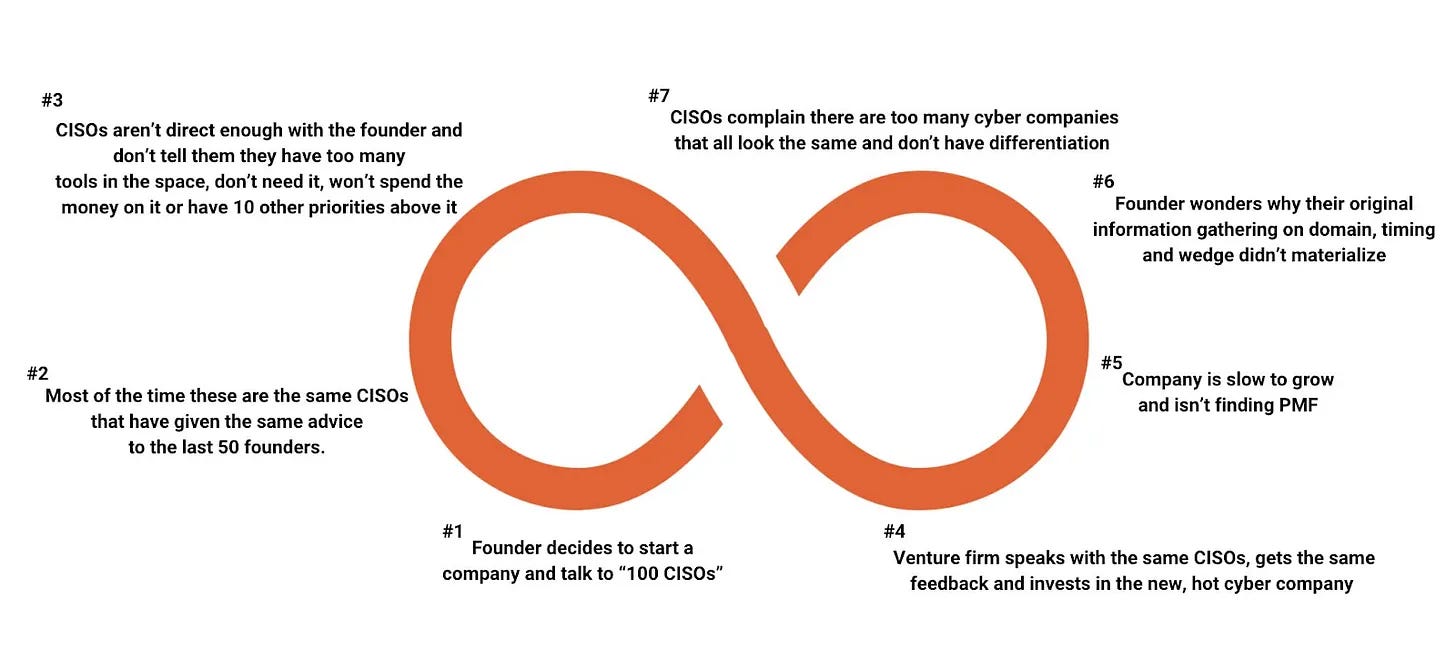
At some point, having a picture of the round announcement in front of Nasdaq gets boring. And, at some point, launching a website that has the same vibe as Wiz might not have the results one assumes it will.
Closing thoughts
I want to close this article with three thoughts.
The first one is about Wiz. I am seeing more and more companies that are trying to emulate Wiz’s success by being more Wiz-like. I am seeing more and more websites that are now magical, floating, and light. All this is nice, but here’s one thing people forged: what made Wiz Wiz is precisely the fact that they didn’t follow anyone’s playbook. They didn’t copy. They created. They did things their way, instead of trying to be CrowdStrike, Check Point, Zscaler, or Palo Alto Networks. And, it’s in their authenticity that they found their own way. Wiz is a once-in-a-decade success, and these successes always look different. The next Wiz will look nothing like Wiz. And on that note, the next Koi probably won’t look exactly like Koi 2.0.
The second is about survivorship bias. The majority of the startups do not succeed, and if you were to peel back the celebratory announcements of the majority of the exits, you would also find that many of these “amazing news” stories are actually not that amazing (or even pretty unfortunate). Everyone is trying their best, that’s all.
The third one is a message that goes to my fellow US founders. I strongly believe that there are many different ways to be successful, and I think the market continues to prove that as well. The Israeli ecosystem has perfected the playbook that produces great acquisitions, but the largest independent companies continue to be American. Palo Alto Networks is sort of in-between (founded by Nir Zuk, but it has for a long time been run by Nikesh and the professional team), but Zscaler, CrowdStrike, Fortinet, Cloudflare, Okta, and many others are yet to be overtaken by their Israeli counterparts. The United States has a lot of security talent. For the most part, it is not concentrated in a single area (not the combination of cyber and product talent anyway), but it is here. Customer proximity brings a lot of advantages. Security is not a winner-takes-all market, and there can be many winners.
There is a lot of demand for security innovation, and not all the companies that will win in the next decade will be Israeli.
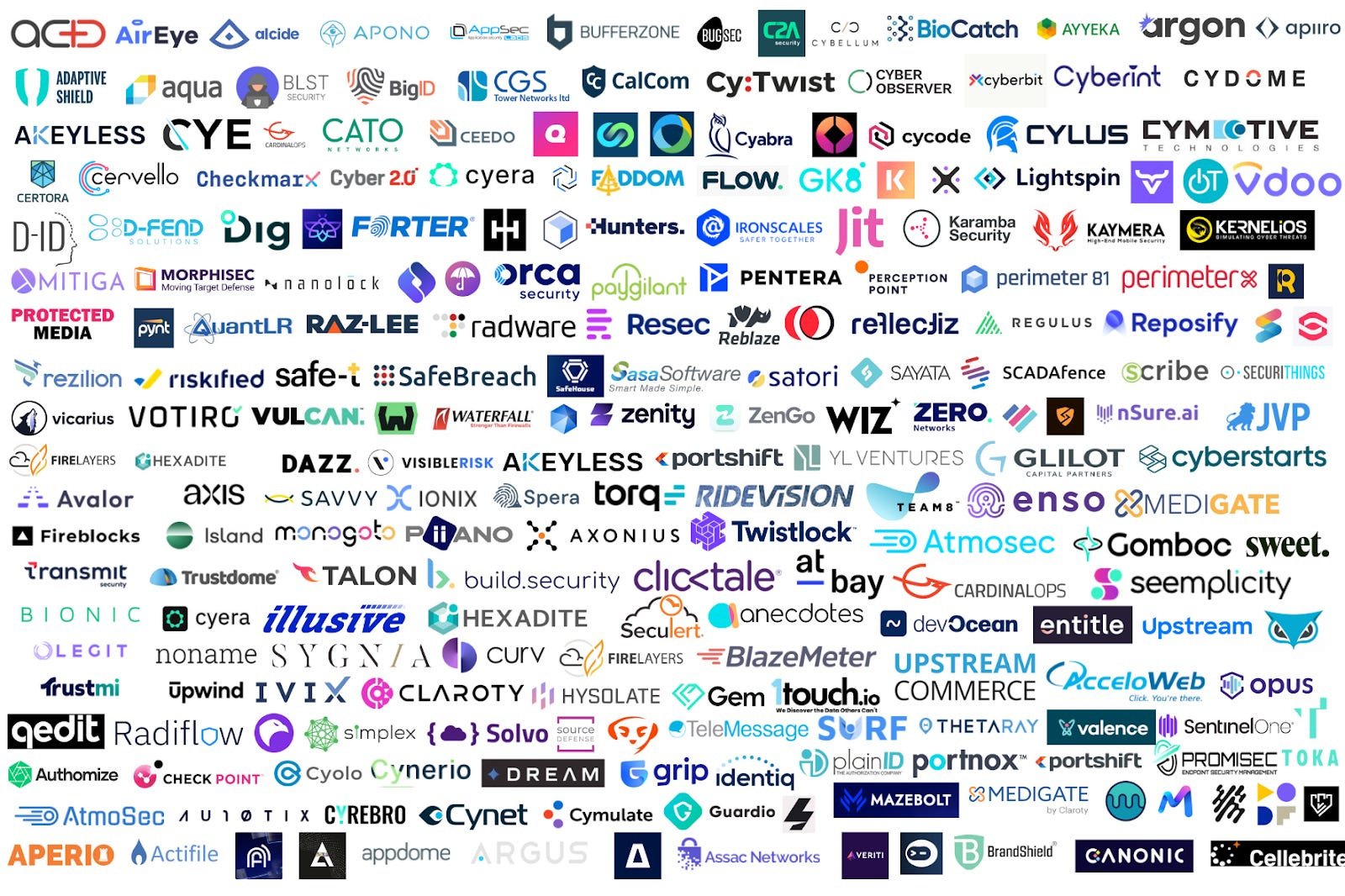
P.S. This image is old, and yes I know I’ve “missed many logos” - please forgive me that, fellow founder friends :) It is not meant to be exhaustive in any way, you’re all awesome.
Security is the top most important subject in Israel, pushing the ecosystem to the edge of technology. As you said correctly, VCs support in Israel for early-stage startups has a totally different perspective than the rest of the world, even bay area. VCs there hunt new ideas rather can evaluating ARR, MRR and other financial factors. This brings the founders together to work on new ideas and come up with novel solutions to security problems rather than thinking about the business model. I don't say business model is not important, my point is on threshold of risk they take to invest on innovation.
The article provides a detailed explanation for why Israel has become a dominant force in cybersecurity startups, highlighting factors such as military service networks, founder support systems, concentrated talent, and active venture capital participation. However, it presents these advantages largely in isolation and avoids discussing the broader political, military, and ethical context that has contributed to the development of this ecosystem.
For example, the article repeatedly praises the close relationships formed through military service, describing them as a source of trust, loyalty, and entrepreneurial success. What it does not address is that many of these networks originate within military and intelligence organizations whose activities remain highly controversial internationally. The same military institutions credited with producing cybersecurity talent have also been accused by human rights organizations of facilitating surveillance, occupation, and other practices that critics argue violate the rights of Palestinians. By focusing exclusively on the innovation benefits while ignoring the human consequences, the article presents only one side of the story.
Similarly, the piece describes Israel's cybersecurity success as an "existential" collective effort and praises the national unity behind it. Yet it never examines how this national project impacts those living under Israeli control who do not share equally in the economic benefits, political rights, or opportunities celebrated in the article. The result is a narrative that highlights prosperity, investment, and technological achievement while overlooking the experiences of populations affected by Israeli policies.
The article also treats Israel's startup ecosystem largely as a meritocratic success story, emphasizing founder support and venture capital networks. Missing from the discussion is the substantial role played by government funding, military research, intelligence training programs, and decades of strategic state investment. While these factors do not diminish the accomplishments of Israeli entrepreneurs, they provide important context for understanding how such an ecosystem emerged and why it may not be easily replicated elsewhere.
Ultimately, the article is strongest when explaining how the Israeli cybersecurity ecosystem functions, but it is less balanced when discussing what that ecosystem represents. It celebrates innovation, entrepreneurship, and national cohesion while largely ignoring the political realities, military structures, and human rights concerns that are inseparable from Israel's modern technological development. A more complete analysis would acknowledge both the remarkable success of the ecosystem and the ethical and geopolitical controversies surrounding the institutions that helped create it.
Perhaps you need to educate youself, Ross. Or are you sponsored by the same entity you are praising.